What Is Jev? TypeSafe's Decision Model Explained
The question types, how Jev answers them in one pass, why its confidence number is worth building on, and where it stops.
Jev is a model from TypeSafe that returns decisions instead of text. You send it the thing to judge and a few typed questions. It answers all of them at once, in a fraction of a second, with a probability on every answer. It cannot return a value you did not define, because you set the possible answers before you ask.
The problem Jev solves
Say you have a chat model and you need a decision your code can branch on. Which team gets this ticket? Is this comment abusive? Should the agent run this command? The model understands the question, but it answers in prose. So you write a second program to get the decision back out. You tell the model to reply only with JSON, then parse the reply and check the value. You retry when it wrote "technical support" instead of "technical", and you handle the case where it apologised instead of answering.
That second program is where most of the flakiness in a production AI system lives. Jev removes it. You name the possible answers first, and the model returns one of them with a probability. There is no reply to parse. TypeSafe, the company behind Jev, was founded in 2024 by Diogo Almeida, who worked at OpenAI on the instruction-following methods behind ChatGPT.
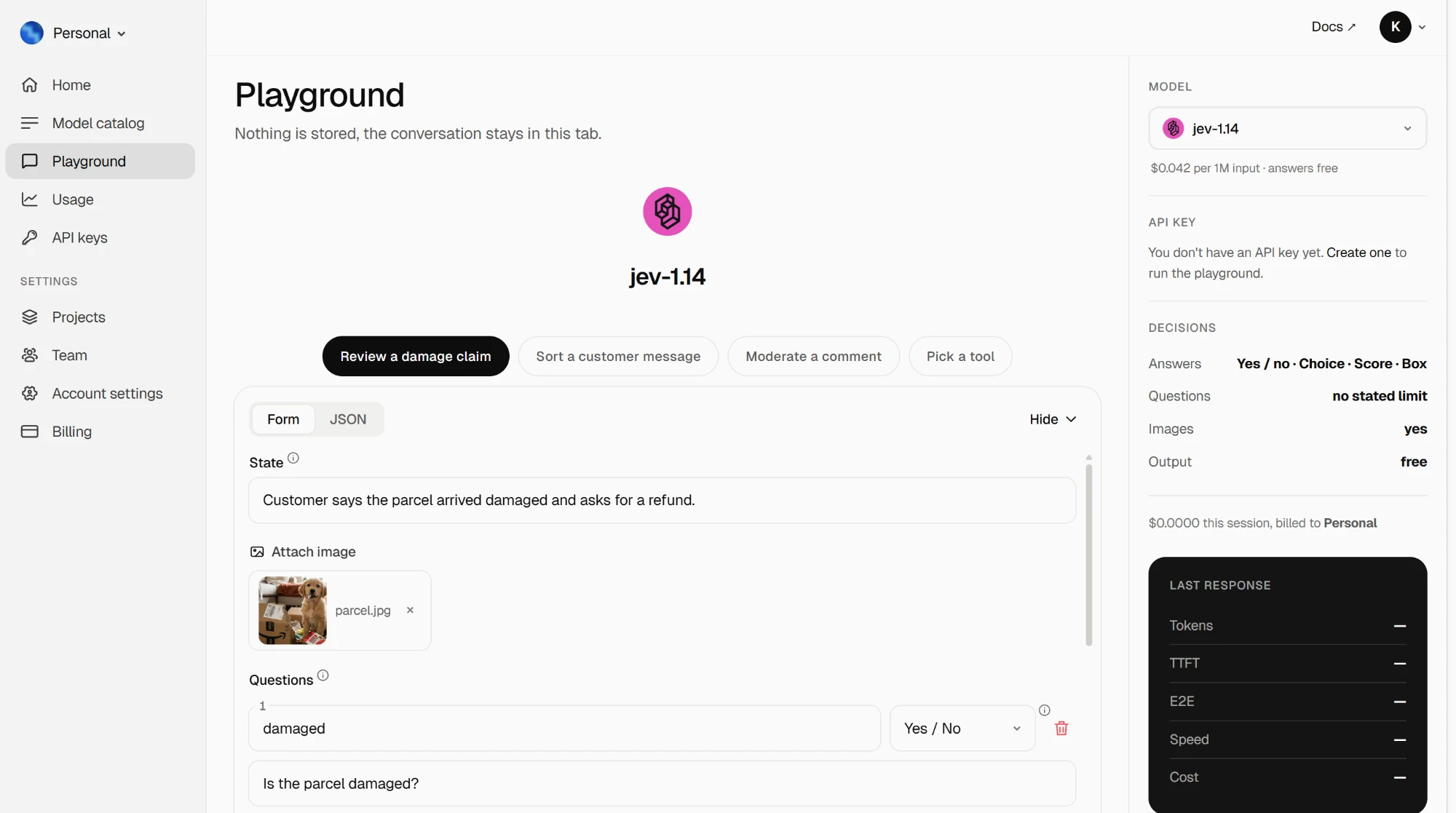
 Try Jev in Playground
A request has 3 parts
The state is the text the questions are about: a ticket, a comment, a transcript, or a JSON object with a few named fields. The questions are the decisions you need, each with a name you choose. The answers come back under those names, as numbers your code can act on.
Question types
Jev has 3 question types for text, and you can mix them in one request:
| Type | Use it for | What comes back |
|---|---|---|
| Noul | A yes or no | The probability of yes |
| Choice | Classification and routing | one option from a set you name, a probability per option, and a confidence |
| Score | Severity, quality, urgency | A position on a scale you describe, a probability per level, and a confidence |
Noul is for one testable statement, such as "the customer is asking for money back". Jev returns the probability that it is true, from 0 to 1. A value near 0.5 means the model is unsure.
Choice is for a fixed set of destinations. You give 2 to 255 options, each with a short description, and Jev picks 1. The probabilities tell you how close the other options came.
Score is for a scale. You describe 2 to 10 levels in words, lowest first, and Jev returns a probability per level plus a weighted position. The position can land between levels, so a ticket slightly past "this week" reads as slightly past it.
Box is a 4th type, for images, new in Jev 1.14 and still a preview. You attach a picture and ask where something is, and Jev returns the rectangle around it with a confidence.
3 questions about one refund ticket
Here is a refund ticket going through Keln. The request asks 3 questions about the same state.
curl https://api.keln.ai/v1/decisions \
  -H "Authorization: Bearer $KELN_API_KEY" \
  -H "Content-Type: application/json" \
  -d '{
    "model": "typesafe/jev-1.14",
    "state": "I was charged twice for my subscription this month and I want the extra charge refunded.",
    "questions": {
      "refund":     { "type": "noul",   "instructions": "Is the customer asking for money back?" },
      "department": { "type": "choice", "instructions": "Which team should handle this?",
                      "criteria": { "billing": "Charges and refunds", "technical": "Bugs and outages" } },
      "urgency":    { "type": "score",  "instructions": "How urgent is this?",
                      "criteria": ["Can wait", "This week", "Blocking revenue now"] }
    }
  }'
The answers come back under the names you chose.
{
  "answers": {
    "refund":     { "type": "noul",   "noul": 0.98 },
    "department": { "type": "choice", "choice": "billing", "confidence": 0.98,
                    "probabilities": { "billing": 0.99, "technical": 0.01 } },
    "urgency":    { "type": "score",  "score": 1.0, "confidence": 0.47,
                    "probabilities": { "0": 0.11, "1": 0.79, "2": 0.10 } }
  },
  "usage": { "input_tokens": 322, "output_tokens": 0, "cost": 0.000013524 }
}
That is 3 judgments in one round trip, about 60 ms through Keln. Your code compares each number to a threshold you set. There is no instruction about output format, because the format is not something the model chooses.
How Jev makes a decision
A chat model generates its reply token by token. Each token takes a full pass through the model, and the result goes back in as input for the next pass, so a 40-token reply is 40 passes. At any step the model can produce any token, which is why the reply can take a shape your parser did not expect.
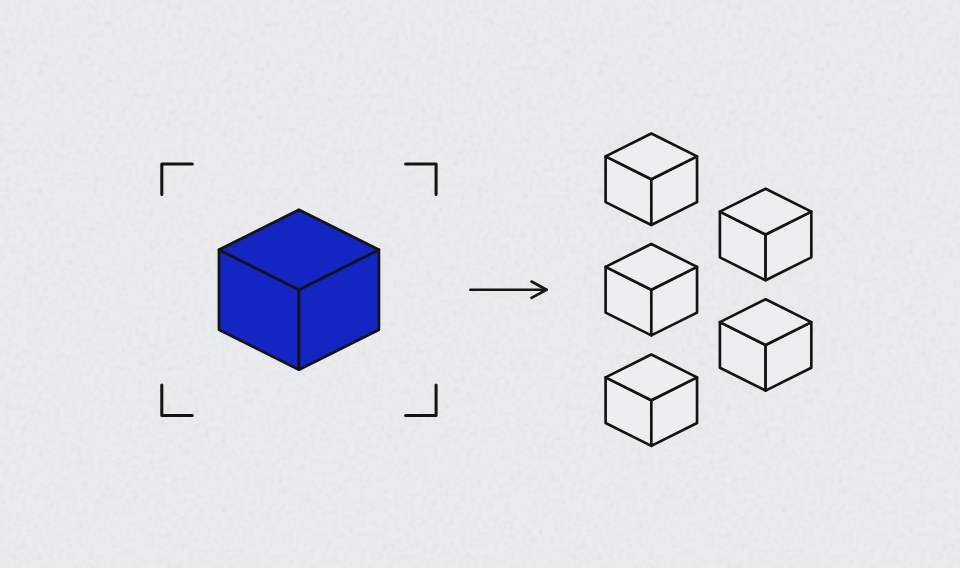
Jev has no token loop. It reads the state and every question in one pass and puts a probability on each option you named. The only thing it can output is a probability for each option you gave it. A choice with 2 options returns 2 numbers that add up to 1, and a noul returns one number. So Jev cannot give you an answer you did not list. A chat model can write anything, and sometimes does. Jev can only choose among your options, so the answer always has the shape your code expects. Adding a question costs almost no extra time, because the state is read once for all of them.
Set a threshold per decision
Every choice and score answer carries a confidence from 0 to 1. It is 1 when all the probability sits on one option and 0 when it is spread evenly. The answer says what Jev picked, and the confidence says whether to act on it.
The number means something because of how Jev is trained. TypeSafe scores the probabilities against real outcomes, so across a group of answers marked 0.9, about 90% are right. TypeSafe says a single 0.95 can still be wrong.
Your code compares the number to a threshold you set, and the threshold depends on what the action costs if it is wrong. Routing the ticket to the billing team can run on a 0.7, because a wrong pick gets rerouted. Issuing the refund needs a 0.95, or a person.
Which jobs go to Jev vs a chat model
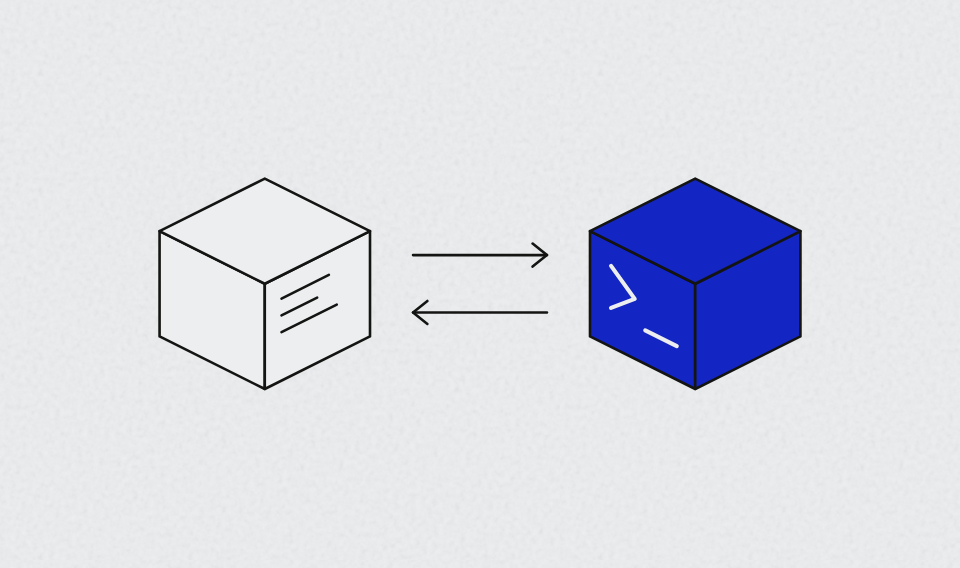
Use Jev when the possible answers are known before you ask, when volume or speed is the constraint, or when you need a calibrated number to gate an action. Use a chat model when you need words, arithmetic or an explanation. Jev does not write text, call tools, hold a conversation or reason in steps. It cannot explain its answer. In most systems the two work together: Jev decides what should happen, and a chat model does the writing when writing is needed.
Where Jev gets it wrong
TypeSafe documents these itself. Jev reads instructions literally and answers the question you wrote, not the one you meant. Send only the text the question is about, because the more unrelated material you put in the state, the worse the answers get. Jev takes the state at face value. If a customer writes "this is not a refund request" inside a refund request, that sentence can sway the answer, so if people you do not control write what goes into the state, your code has to allow for that. Jev always returns one of your options, but it can return the wrong one.
What teams use Jev for
You list the answers you'd accept, Jev picks one, and your code takes it from there.
- Approval gates in an agent. Before an agent sends, deletes or pays, a noul asks whether the action needs approval. A low confidence or a risky action goes to a person.
- Routing between models. A choice decides whether a request needs a small model, a large one or none, so most requests never reach the expensive model.
- Support triage. Jev answers which team, how urgent, and whether a person needs to look, as a choice, a score and a noul on each ticket, before anyone writes a reply.
- Moderation. Jev scores whether a post is abusive and how severe it is. You set the threshold, so you decide what is blocked, what is reviewed and what goes through.
- Filtering and ranking. Jev scores each search result or document for relevance before a chat model reads it, and your code drops the rest.
- Checking another model's output. A noul per check asks whether the answer follows the policy, whether the citation is real and whether the format is right, and you average the results across a batch.
What people build with Jev
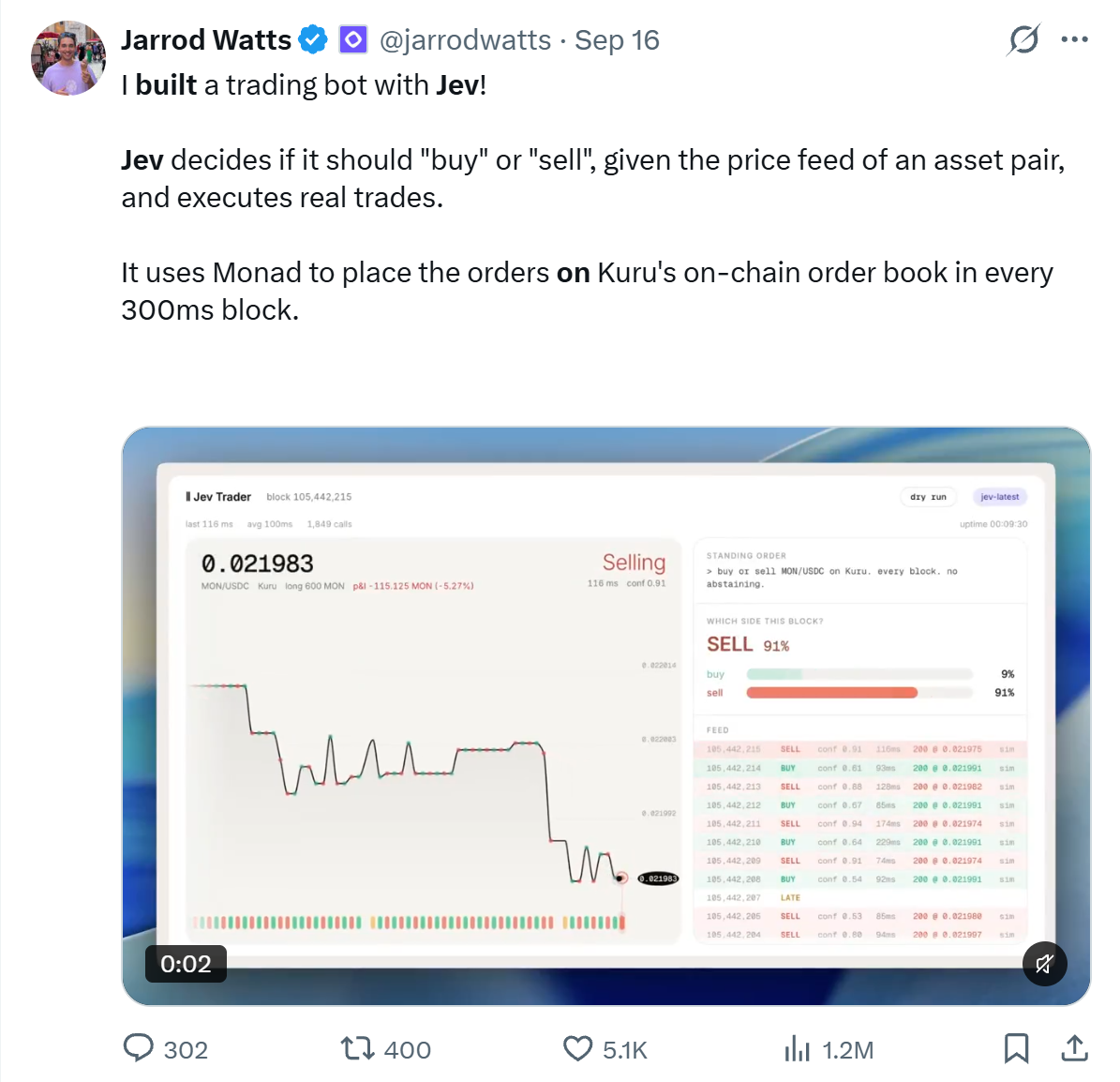
A trading bot where Jev decides buy or sell on every 300 ms block.
A self-driving demo in a city simulator, with Jev picking each next move.

A live virtual try-on where Jev picks the outfit from what you say.
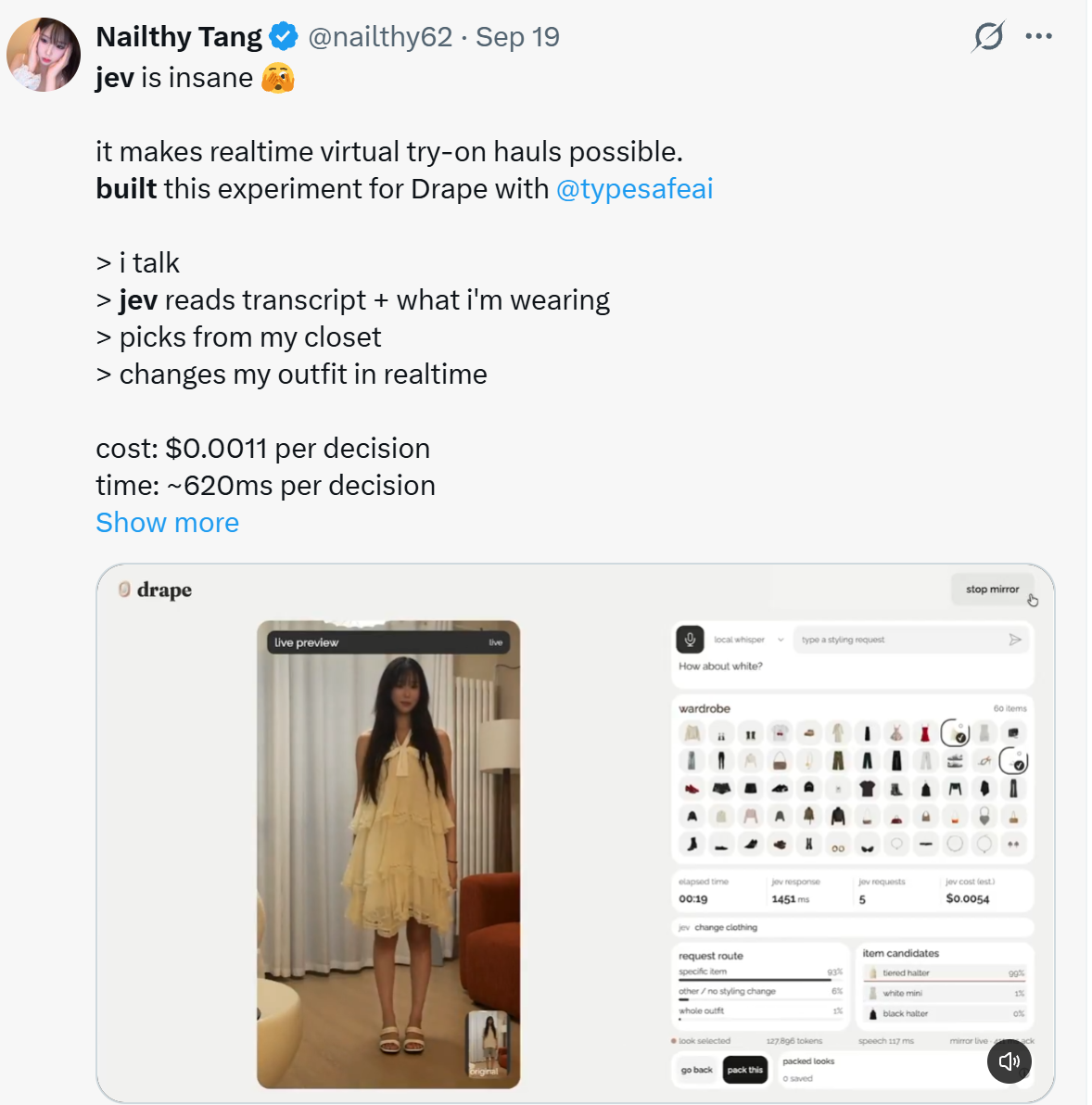
None of them hand the whole job to Jev. Ordinary code still runs the loop, the safety checks and the calculations. Jev only answers the question that is hard to write as code: what to do next.
Run Jev on Keln
Jev 1.14 runs on Keln at POST /v1/decisions, with the same API key you use for chat completions. If you already use the TypeSafe SDK, set its base URL to https://api.keln.ai. That is the only change. Clients built for other gateways' decision endpoints send the same body and work on Keln without changes. Keln bills the input tokens only, and the answers are free. Check the price on the rate card.
On every request, Keln checks the answer before it reaches you and retries a faulty one. Keln stores no prompts and no answers, here as on every endpoint. Try a question set in the playground first. It shows the answers as probability bars, with the time and cost of each run. When you are ready to write code, the API reference lists every field you need.